
Getting on top of Compressed air leaks has a direct beneficial impact on a factories expences.
Compressed air is one of the most expensive utilities to generate, as a rough rule of thumb it costs 10 times the cost of Electricity.
At the same time industry is a huge user of compressed air, often many machines will use compressed air in one or more forms to perform their operation.
https://www.cambscompressors.co.uk/news-articles/2018/11/02/cost-of-compressed-air-rule-of-thumb/
Because of the huge cost of generating and the extensive usage with many machines relying on Compressed Air in order to perform their task and with a move to greener factories and an ever keen eye on expences or the cost to generate the factories product it’s worth your time to reduce compressed air leaks.
Leaks in compressed air systems cost companies thousands of pounds each and every month, in this article on compressed air leaks from IFM they suggest an air leak that is audible costs £500 a year!
This is an audible one, it doesn’t take much of an air leak to reach the audible level, we can back this up with what we’ve seen and the example further down this page.
Compressed air is one of the most expensive utilities to generate and is used in huge quantities in the manufacturing industry.
One of the easiest/quickest ways to reduce costs is to perform a compressed air leak survey – and then repair the air leaks (obviously).
Finding Compressed Air Leaks
Air leaks are often walked past without a second thought, take this example from a recent client we visited, we were testing compressed air leak detection methods recently in a factory that we have worked with for well over a year.
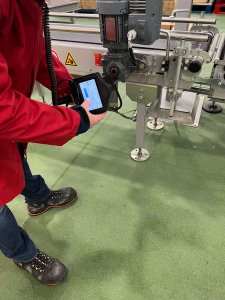
It’s a new factory so didn’t expect to find too many issues. Within a couple of minutes, we’d identified an inconspicuous compressed air leak which (when we ran the figures) was costing the company £500 a year!
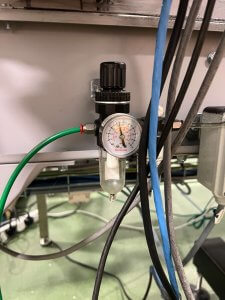
This leak was on a pressure regulating valve on an inkjet printer, what was interesting about this leak is you could walk past it without hearing any issues, without giving it a second thought, even if you did hear the leak it was so small that you would normally just ignore it to wander off and find the bigger fish!
However we were testing a new piece of equipment so wanted to put it to the test, to be fair our normal machine would have found this leak but we were just playing around, to be honest.
We found a leak and run the figures on the app we use, the leak showed 45 Db and at the 4bar pressure, this unit was running at this equated to a £500 per year leak!

In the grand scheme of what it costs a factory to power its equipment this compressed air leak was pretty minor but what is significant is it’s a small compressed air leak on a small asset and is costing the company £500 per year in losses from the compressed air leak.
There may be 100’s similar ‘small’ leaks in the factory!
Another point of note is that we found this compressed air leak after about 5 minutes of performing a compressed air leak survey, 5 minutes and we’d already paid for our time.
How do we find these compressed air leaks? We’ve searched long and hard for the best compressed-air detection methods and have found that ultrasound leak detection is the best, fastest, and most cost-effective way to find compressed-air leaks in an industrial setting.
It’s not just us that believe this, Energy.gov’s guide to removing compressed air leaks from as long ago as 2004 recommends ultrasound leak detection.
“Leak Detection
The best way to detect leaks is to use an ultrasonic acoustic detector, which can
recognize high frequency hissing sounds associated with air leaks.”
Read the whole guide here Reduce compressed air leaks

To be honest, we stumbled upon compressed air leak detection by accident, our main focus since the inception of our company has been to provide Engineering Support to Manufacturers, with this we gradually went deeper and deeper down the reliability-centered maintenance route, and through condition-based monitoring we found ultrasound.
Originally we were interested in this for the benefits of being able to listen to a bearing and hear when it needs more grease and how much but we also found that we could use this technology to find compressed air leaks, having worked in the manufacturing sector for 20+ years we knew that air leaks cost companies thousands so when we learned of the potential for using ultrasound to also listen for air leaks and perform compressed air leak surveys for our customers we were intrigued, to say the least.
The thing with ultrasound is that it is inaudible to the human ear, so the ultrasound listening device to listen for compressed air leaks and other ambient noise isn’t picked up, so the general noise of the factory is not recognised.
The factory in question has an ambient noise level of around 75 DB, our leak was only 45Db so it’s very unlikely you would notice it and in the grand scheme of things it’s a very small leak.
But still costs the company £500 a year!
It’s not unheard of to find leaks to the value of £10’s of thousands of £ in a single survey.
Meaning savings to the company of £10k, £20k, £30k, or more in a single survey.
Obviously, you have to fix the leaks, this is where most companies struggle in my experience, as an engineer that’s worked in many FMCG factories I’ve known about the importance of reducing air leaks to the profitability of the factory.
The problem usually is resources, as someone that has always been focused on delivering results rather than ticking boxes obviously that didn’t sit well with me.
So in order to assist companies to get these savings and get a reduction in their energy bills we can perform the air leak survey and also plan the work to remove the leaks.
To book an air leak survey from us using our state-of-the-art ultrasound air leak detection equipment simply use the contact us box, and we’ll be in touch quickly to arrange a time for the compressed air leak survey.